Hospital and clinic signage design: wayfinding, sizes, materials and mistakes to avoid
Short answer Good hospital or clinic signage helps a worried visitor find the right place without asking anyone. Plan the visitor’s route first, use one clear naming system, choose large high-contrast lettering that is readable from the right distance, pick durable materials that are easy to clean, and have a designer check every sign on […]
Good hospital or clinic signage helps a worried visitor find the right place without asking anyone. Plan the visitor’s route first, use one clear naming system, choose large high-contrast lettering that is readable from the right distance, pick durable materials that are easy to clean, and have a designer check every sign on site before final printing.
People arrive at a hospital or clinic stressed and in a hurry. If they cannot find reception, the lab or the pharmacy, they lose time and your staff lose patience. Signage is not decoration. It is part of how a healthcare space works.
1. Start with the visitor’s route
Walk the building as a first-time patient: gate, parking, entrance, reception, waiting area, consulting rooms, lab, pharmacy, exit. Note every point where someone has to decide where to go. Each of those points needs a sign.
2. Use one naming system
Decide the exact name for each area and use it everywhere: on the board, the door sign, the appointment slip and the website. Do not call the same room “Pathology” on one sign and “Lab” on another.
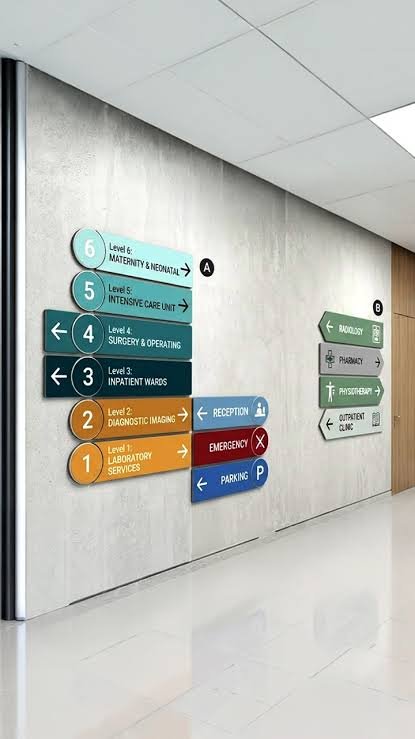
3. Types of signs a healthcare space needs
| Type | Where it goes | What it does |
|---|---|---|
| Exterior board | Building front, gate | Tells people they have reached the right place |
| Directional signs | Corridors, junctions, lifts | Shows the way with arrows |
| Room and door signs | Next to each door | Names the department or room |
| Floor and lift directory | Lobby, each landing | Lists what is on each floor |
| Safety and information | As needed | Exits, hygiene, silence, restricted areas |
Test readability before you print. Stand at the real viewing distance in the real light, with a printed sample on the wall. A sign that looks fine on screen is often too small in a long corridor.
4. Letter size, colour and contrast
- Use plain, open typefaces with clear letter shapes. Avoid thin or decorative fonts.
- Keep strong contrast between text and background, for example white on dark blue or dark text on white.
- Make the main word larger than the supporting text, and keep spacing generous.
- Use colour coding for floors or departments, but never rely on colour alone.
- Use familiar icons for restroom, lift, stairs and exit.
5. Choose materials for a clinical space
Signs in hospitals are touched, wiped and sometimes bumped. Acrylic, aluminium composite panels and metal letters are common choices because they are easy to clean and hold their finish. Backlit boards help in dim lobbies. Pick materials with your sign vendor based on the wall, lighting and budget.
We design signage systems for clinics, hospitals and healthcare brands in Pune, from the exterior board to door signs, in the same look as your brand. Send your floor plan on WhatsApp and we will suggest a sign list.
6. Keep it matched to your brand
Signage is the largest print job most healthcare brands have. Use your brand colours, fonts and logo rules so the building looks like the same organisation as your website and printed material. If your brand rules are not written down yet, start with our guide on what to include in brand guidelines. For a printing checklist, see how to prepare print-ready artwork.
Common mistakes
Too much text on one sign
Keep each sign to what the visitor needs at that moment: a name and an arrow.
Inconsistent names and styles
Different fonts and names across floors make the building feel confusing.
Ignoring the final location
Lighting, wall colour, glass reflections and distance change how a sign reads. Always check on site.
Forgetting future changes
Departments move. Use door signs with replaceable inserts where rooms change often.
Packaging design · Pharma design and printing · Print, signage and visual aids · Contact us for a quote
Questions and answers
What signs does a clinic need?
At minimum an exterior board, a reception sign, directional signs, door signs for each room, a floor directory if you have more than one floor and basic safety signs.
What is the best material for hospital signs?
Acrylic, aluminium composite panels and metal letters are common because they are durable and easy to clean. Choose with your vendor based on the wall, lighting and budget.
How large should the letters be?
It depends on the viewing distance. Test a printed sample at the real distance and in the real light before final production.
Can you match signage to my brand?
Yes. We design the full signage set using your brand colours, fonts and logo so it matches your website and printed material.

A design studio in Pune, Maharashtra making logos, brand identities, packaging, websites and campaigns for companies that sell real products and services.